A Hyper Surveillance State Won’t Protect Kids
Author: kiwi dillard
Was age verification solely ever about protecting children? This is something I had begun to question years ago, when the call for bans on pornography had once again arisen into online discourse. Initially, I was hesitant to write about this issue, given its touchy and taboo topics. However, due to recent events, I decided to muster up the courage and speak up about not only this, but my experience, despite the risk of making myself vulnerable to any disingenuous and bad-faith takes about what I had gone through, but I felt it was crucial for me to do so in order to write this piece.
The restriction of access to social media, online gaming, and general bans on pornographic content are not the wins people may think they are; the Kids Online Safety Act (KOSA) and its debatably, many copy cat bills, one which had passed this month, renamed as the Kids Internet and Digital Safety Act (KIDS Act), will not keep anyone's kids safe like we were told. It is no coincidence that the narrative otherwise, is currently being pushed in such a conservative political climate, and it all starts with censorship. The connection between these topics is the self-righteous moral sentiment; in this case, being framed as, "Won't someone think of the children?" Legislation prohibiting anything considered "obscene", "immoral", or "degenerate" is not new, but it has always had negative consequences not only in regard to freedom of speech, but impacting marginalized communities as well.
Just during last summer, a radical feminist group named the Collective Shout, based in Australia, went viral for running an email campaign that targeted over 500 video games that depicted sexual abuse, rape, torture, incest, among other things. (1) The public pressure they, and their supporters, collectively put on the gaming platforms these games were published on, such as, Steam and Itch.io, and by extension the payment processors they do business with, such as, Mastercard, Visa and PayPal, ultimately forced the gaming platforms to comply or else they would have no longer be able to provide their users with payment options. This action had not only caused these games to be shelved, but also fundamentally changed the terms of service of what could, and could not, be depicted on the gaming platforms they were published on, but also, the policies of the payment processors in regards to what could, and couldn't, transactions be for.
The cause of this group seems noble at first glance, that is until you look deeper to recognize the ramifications. It is important to note that the Collective Shout has ties to the groups the National Center on Sexual Exploitation (NCOSE) and Exodus Cry, both based in the U.S., and infamous for their advocacy of abstinence-only sex education, anti-abortion, anti-pornography, anti-LGBTQ+ stances and much more. Notably, the NCOSE was once named the Morality in Media, and had backed the EARN IT Act in the year 2023, which was a copy cat bill with the intent to override privacy rights under the guise of eliminating sexually exploitative material off the internet. The Exodus Cry, on the other hand, is an evangelical Christian group that has been known to target OnlyFans since the year 2021.
With what was once their cause, to take down games that featured depictions of sexual abuse, had quickly escalated into something more extreme, as they began to take down games that even hinted towards the subject in discussion, regardless of the intent. From there, it was no longer about the depictions of sexual abuse or rape, but rather, any depictions of disturbing imagery entirely. They had begun to target horror games. An example of this being "VILE: Exhumed", a feminist point-and-click horror game developed by Final Girl Games and DreadXPGames, that tells a story about the entitlement of misogyny, where the player searches through a computer and uncovers information about an adult film actress. (2) Why exactly was the game shelved? Because the head developer had used real photos of herself, censored via blur to fit Steam's standards prior to the ban, to portray the character of the actress. If the objective is to take down games that sexualize the subject of sexual abuse, why take down ones that tackle the subject seriously with the same vitriol? As if those two forms of execution are of equivalence?
The recurring pattern of creatives, developers, and sex workers whose work was independently published, being negatively impacted in the crossfire of this endeavor does not go unnoticed. The targeting of marginalized identities also correlates when people are simply put into the crossfire by association, with queer representation once again being called into question if it is a "mature" topic. Since last year, even more games have been shelved, no longer just for depicting sexual abuse but for daring to depict queerness. Including Grunge, an award winning game by the developer CrossXGames whose story is a coming of age one, about young queer love between characters in high school, that does not depict any visuals nor discussion of sexual abuse. (3) Earlier this year in April, the Federal Communications Commission (FCC) had released a public notice requesting public commentary on whether or not the TV Oversight Management Board (TVOMB) of the U.S. should essentially create warning labels to "alert" viewers in advance for any on-screen discussion of gender identity, transgender, and non binary themes, in the form of new TV ratings. (4) The implication that any themes in regards to gender should require explicit ratings implies the false notion that anything in regards to gender is obscene, when that is far from the truth. This sends more of a harmful, misleading message towards audiences than anything else. Furthermore, in what way does this actually protect children? It doesn't.
As of late, we've witnessed legislative decision-making from world leaders across the globe that has been counterproductive towards the objective of online safety. Such as the Online Safety Act from the U.K. to the Online Safety Amendment (Social Media Minimum Age) in Australia, are prime examples of harmful legislation being passed that violates the privacy of citizens, under the guise of protecting children online. Re-focusing this issue on to the U.S. its current political climate. This is a country where ICE raids and kidnappings have become frequent, where Flock cameras utilized by law enforcement departments have become widespread across the nation, where the FBI has announced that any citizens posting anti-Trump political sentiment on mainstream social media platforms, such as TikTok and Instagram, are to be put on the watchlist, as that is grounds to be labeled as a domestic terrorist, etc. The impending threat of the KIDS Act will make the internet less accessible unless if people relent and create digital IDs; tying their real-life identities to their online activity. Arguably, this will make the targeting of citizens easier for ICE agents; when it gets to a point when we are legally required to provide our verifiable credentials, such as biometric information and government identification for even tame things. There are many things our politicians could have done to protect the children of our country, unrelated to online safety even, but with all the redundant bills only meant to gut our right to privacy rather than provide us solutions, do our leaders really have our children's best interest in mind? Noticeably, no other demographic in this country has ever been used as political chess pieces for moral talking points as often as children have been. Yet ironically, they are the least protected. Even in their own schools.
The discourse surrounding the safety of children being online lacks nuance, as the lived experiences of those who are impacted the most are often left out of the conversation or spoken over. I still have so many stories to tell, and yet they would never influence legislation because how often is it that youth voices have a say? So would age verification alone have been enough to protect me? The answer is no, and a primary factor was due to the way my parents fear-mongered about the internet, unable to educate me at all on how to keep myself safe online, which left me unequipped with the knowledge on how to protect myself. Especially not from the predator I had formed a relationship with. How does a kid without a support system even break out of that? While I did defy the odds and muster up the courage to do it on my own, I didn't do it without leaving unscathed. Nor without being shamed and victim-blamed by people who were too uneducated and tech illiterate to understand what had happened to their child. Grooming can happen anywhere; it is an accumulation of vulnerable factors that create opportunities for children to be preyed on in the places you'd least expect, even from the people you’d least expect; groomers are not the boogeyman from mothers' basements as we portray them to be. They can be everyday people in our lives, and teaching children otherwise only puts them in danger. It is a multi-faceted issue, and it is never as simple as just because of "that damn phone."
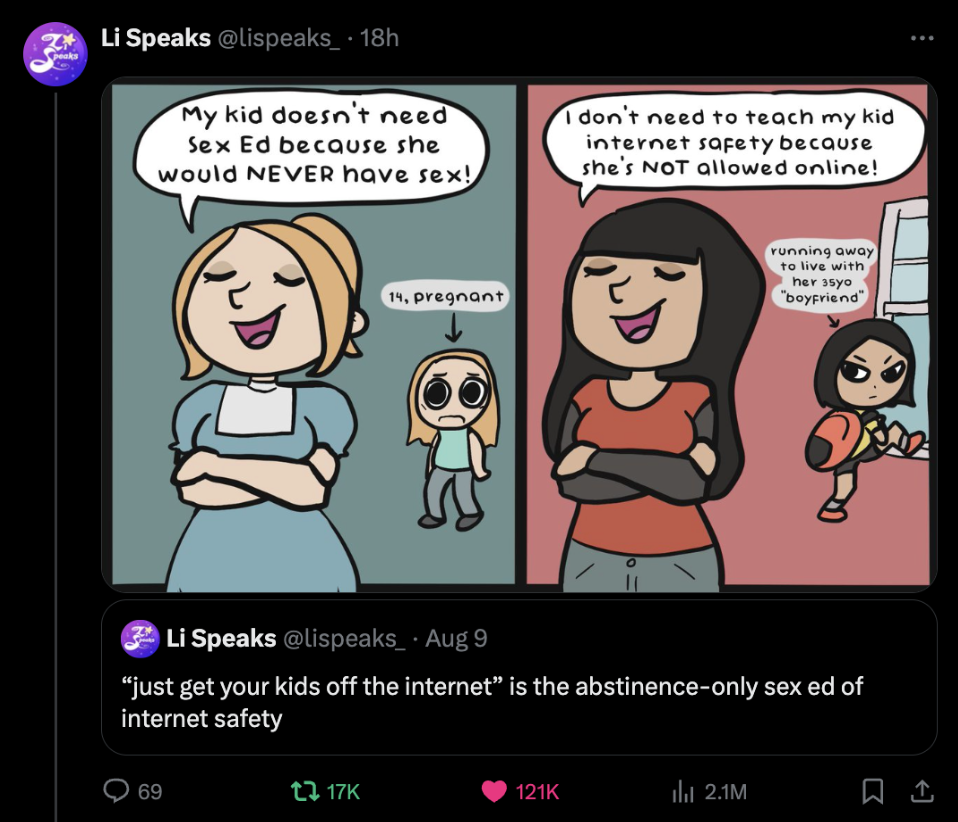
When I see parents backing legislation that pushes the narrative that responsibility solely lies on tech corporations to keep their kids from harm's way, not only does it leave a bad taste in my mouth, but it also comes off as extremely irresponsible. It takes the responsibility away from parents, and places it into the hands of tech corporations that have been taking advantage of children for monetary gain for years, when both should equally be held accountable. As a survivor, it is glaringly clear to me that this is about government hyper-surveillance, and it's disingenuous to weaponize children as a talking point, even when in grief. It is horrifying to me how normal it is for parents to use tablets connected to the internet as substitute pacifiers for their children, it's so normalized it even occurs in public. While on the opposite end, fear-mongering about the internet from strict parents only creates sneaky children. While both parenting styles may seem different, they provide the same results: a lack of engagement. In a modern tech-driven society, a child gaining access to a device is inevitable, and it is a disservice to a child to avoid educating them about online safety. When in reality, parents should be engaged with their children, have healthy conversations about what they see on the internet, how it makes them feel like, and what it makes them think; be involved in their online activity!
The censorship and restriction that the KIDS Act will bring won't keep your kids safe, it is ultimately tech literacy and safety skills that will equip children with the knowledge to make well-informed decisions when they need it the most. It is because of these issues that I implore parents to make an effort to understand, to prompt these kinds of conversations with their children, to be involved with their children’s online activities, as these are all things that cannot be done without having healthy and communicative relationships with their children. Bans on media based on the content they contain have always been a slippery slope into malicious territory throughout history, and while some things most definitely should not be consumed by kids, it should not be solely up to tech corporations to keep children safe, and certainly not at the cost of the prohibition of mature imagery.
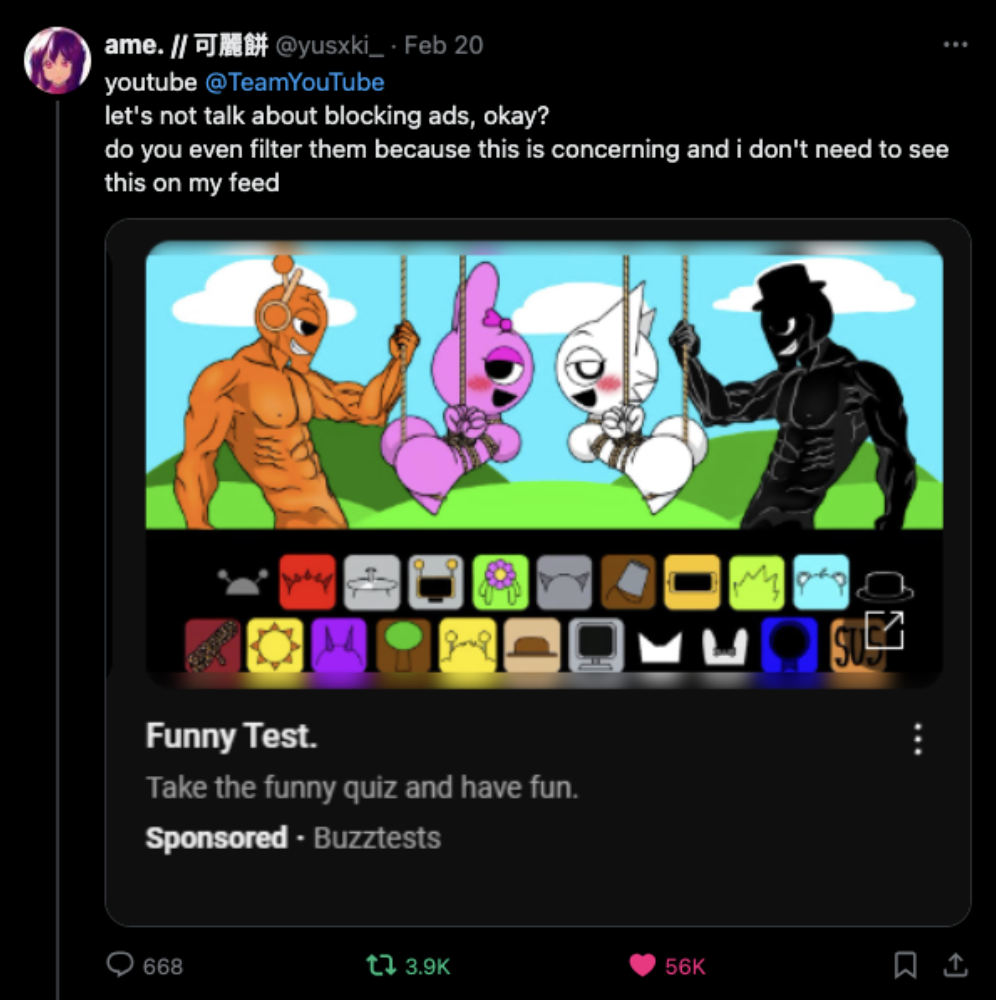
It is possible for solutions to be implemented without putting people in danger of the crossfire, all while simultaneously holding tech corporations accountable. But that has yet to be put into practice. Especially when COPPA's 2019 lawsuit with Google resulted in essentially a buy-out of accountability to the Federal Trade Commission. If anything, rather than the "Made For Kids" label being a solution, it has only allowed Elsagate content and advertisements to evolve into what they are now under the radar, a rampant influx of AI-generated slop, on the failure of a sister platform that is YouTube Kids. The plethora of creators who have independently published their work on YouTube for years, despite labeling their context as "Not For Kids" and receiving the short end of the stick, can attest to that. It is imperative that youth voices be involved in the legislative process. As it has become clear that progression is impossible without the input of those who are impacted, and look out for others who will be too. An example of this is the Pupil Instruction: Digital Wellness bill, in opposition to the Phone Free Schools Act, that is currently in progress. For the youth, authored by the youth. (5) Rather than being counterproductive, it promotes the concept of educating youth from K-12 to develop digital literacy skills in relation to mental health awareness. This sets children up for success, rather than failure, as a complete ban would do.
References:
1. Roper, C. 19th July, 2025. "Win – New policy on Steam and rape + incest games removed." Collective Shout. https://www.collectiveshout.org/win-new-steam-policy-games-removed
2. Cadaver, C. 28th July, 2025. "A disappointing update about VILE: Exhumed…" Twitter.https://twitter.com/dirtlord77/status/1949867514797707531
3. Dugas, T. P. 5th August, 2025. "Thousands of games have been censored from major platforms, with LGBTQIA+ creators caught in the crossfire." The Conversation.https://theconversation.com/thousands-of-games-have-been-censored-from-major-platforms-with-lgbtqia-creators-caught-in-the-crossfire-262040
4. "Defend Our Freedom To Be Seen: Tell The FCC That Lgbtq Stories Don’t Need A Warning Label." April 23, 2026. Gay and Lesbian Alliance Against Defamation.https://glaad.org/fcc/
5. Sanganeria, V. 16th April, 2026. "California students author new ‘digital wellness’ bill, say school cellphone bans fall short." April 23, 2026. EdSource.https://edsource.org/2026/social-media-ai-mental-health/755990